

AI Agents in MedTech
In the fast-paced world of medical technology, we’ve all seen AI agents in MedTech make impressive strides. From helping radiologists spot anomalies in scans to summarizing patient notes, AI has become a helpful assistant. But here’s the thing: most of what we call “AI” in MedTech today is still just a tool—powerful, yet reactive and limited.
The real shift happening right now is toward AI agents that are autonomous, goal-oriented systems that don’t just respond when asked, but think, plan, adapt, and act on their own. As someone who’s followed healthcare innovation closely, I believe this move from tools to agents isn’t just an upgrade. It’s the game-changer MedTech needs to tackle rising costs, clinician burnout, and increasingly complex patient care.
Understanding the Difference: AI Tools vs. AI Agents
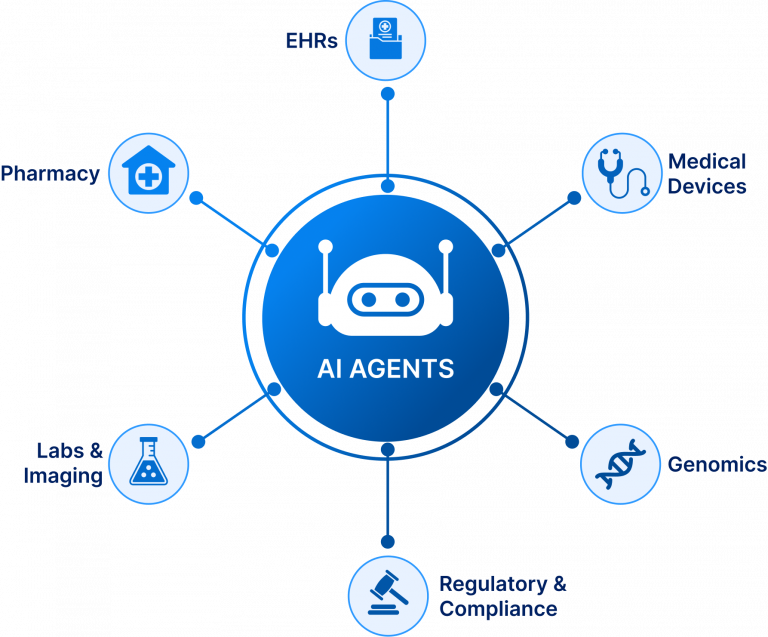
Let’s break it down simply. AI tools are like a very smart calculator. You input data or a prompt gives you an output, a diagnostic suggestion, a report summary, or an image analysis. They excel at single, well-defined tasks but need constant human direction. Think of traditional chatbots, image recognition software, or basic predictive analytics.
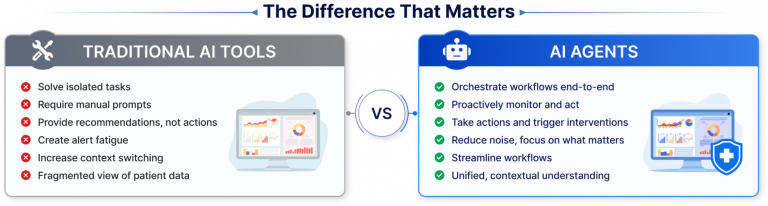
AI agents in MedTech, on the other hand, operate more like a capable colleague. They can set goals, break down complex tasks into steps, use multiple tools, remember past interactions, adapt to new information in real time, and execute actions with minimal supervision.
For example, while an AI tool might analyze a single CT scan when prompted, an AI agent could continuously monitor a patient’s vitals, cross-reference lab results and history, flag risks, suggest treatment adjustments, alert the care team, and even update records while learning from outcomes.
This autonomy makes all the difference in MedTech, where delays, fragmented data, and high-stakes decisions are everyday realities.
Why MedTech Needs the Shift From AI Tools to AI Agents
MedTech companies and healthcare providers face mounting pressure. Administrative tasks consume nearly half of clinicians’ time. Patient data grows exponentially across devices, EHRs, wearables, and genomics. Regulatory requirements are strict, and the talent shortage isn’t going away. Healthcare’s complexity, time-criticality, and multi-system interdependencies make it perfect for AI agents:
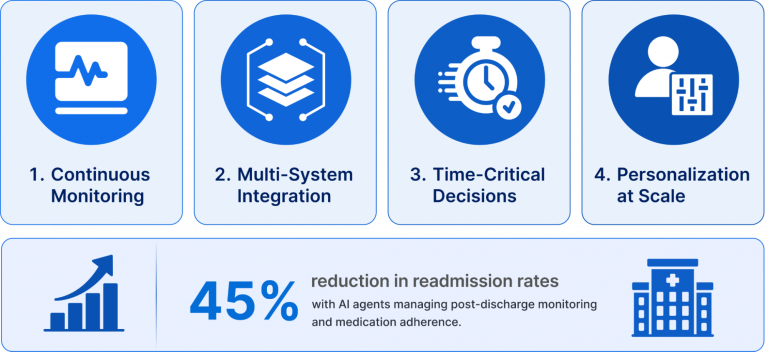
Continuous Monitoring: Patient conditions evolve hourly. Waiting for manual clinician requests is clinically inefficient. Agents monitor continuously, detecting deviations in real-time before conditions become critical.
Multi-System Integration: Patient care requires coordinating pharmacy, labs, imaging, and clinical notes. Medications interact with other medications and genetic profiles. Traditional tools analyze elements in isolation; agents maintain awareness of interdependencies, preventing adverse interactions.
Time-Critical Decisions: Septic shock, stroke, trauma—minutes matter. Agents interpret vital signs, imaging, labs, trigger protocols, and mobilize resources autonomously, faster than traditional workflows.
Personalization at Scale: Each patient is unique. Agents adapt recommendations based on individual trajectories, genetic profiles, and preferences, delivering truly personalized medicine.
45% reduction in readmission rates when AI agents managed post-discharge monitoring and medication adherence
Traditional AI tools help with isolated problems but often create new bottlenecks, more data to review, more alerts to verify, and more context switching for already overloaded teams. AI agents address the bigger picture by orchestrating workflows end-to-end.
How AI Agents Are Changing MedTech
Here are some compelling areas where AI agents are already delivering results:
- Clinical Documentation & Scribing: Agents listen to consultations (with permission), extract key details, generate accurate notes, code them for billing, and update EHRs — often saving clinicians over an hour per day.
- Patient Triage & Monitoring: An agent can assess incoming symptoms, pull relevant history, prioritize cases, and even coordinate follow-ups or remote monitoring for chronic conditions.
- Drug Discovery & Device Development: In MedTech R&D, AI agents simulate molecular interactions, design experiments, analyze trial data, and iterate faster — compressing years of work into months.
- Administrative Workflows: From prior authorizations and claims processing to supply chain optimization for medical devices, agents handle multi-step processes that adapt to changing regulations or patient status.
- Personalized Care Pathways: Agents integrate data from implants, wearables, and records to provide tailored recommendations and proactively adjust care plans.
AI Agents Transform Real-World Applications in Healthcare
ICU Sepsis Management
Challenge: Sepsis kills one person every 15 seconds. Early recognition is critical but difficult.
Agent Solution: Monitors vitals, lab markers, and fluid balance in real-time. Detects sepsis indicators, automatically triggers institutional protocols, notifies physician teams via alerts, prepares blood cultures, and adjusts fluid administration all within seconds.
Outcome: Time-to-antibiotic-administration reduced from 3.2 to 1.1 hours, improving survival rates.
Cardiology Remote Monitoring
Challenge: Heart failure patients need frequent monitoring; episodic telemedicine misses decompensation.
Agent Solution: Continuously analyzes data from implantable devices, wearables, and patient-reported symptoms. Detects hemodynamic shifts, adjusts diuretics, coordinates with pharmacy, schedules visits, and educates patients autonomously.
Outcome: 40% reduction in acute decompensation events and hospitalizations.
Comparison Table: AI Tools vs. AI Agents in MedTech
| Aspect | AI Tools | AI Agents |
|---|---|---|
| Operation Style | Reactive, prompt-based | Proactive, goal-driven |
| Task Complexity | Single-step or narrow | Proactive, goal-driven |
| Adaptability | Limited, needs reprogramming | Learns and adjusts in real time |
| Learns and adjusts in real time | High (constant oversight) | Low (acts autonomously with safeguards) |
| Example in Diagnostics | Analyzes one image | Monitors patient holistically & suggests actions |
| Typical Time Savings | 10-30% on specific tasks | 50%+ across entire workflows |
Data synthesized from industry reports and implementations (2025-2026).
Key Benefits Driving Adoption
The advantages go beyond efficiency. AI agents improve accuracy by reducing human error in repetitive tasks, enhance compliance through consistent audit trails, and enable truly personalized medicine at scale. Hospitals using them report better patient satisfaction and lower burnout rates among staff.
For MedTech companies, this means faster innovation cycles, smarter connected devices, and new revenue streams through agent-powered platforms.
Challenges Ahead
Of course, it’s not all smooth sailing. Data privacy, regulatory approval (especially under FDA or EU MDR), integration with legacy systems, and building trust remain hurdles. The solution lies in human-centered design, such as agents as reliable teammates, not replacements, but with strong governance, explainability, and continuous validation.
Start small: Pilot agents on well-defined, high-pain workflows before scaling.
The Future: AI Agents as the New Standard in MedTech
The shift from reactive AI tools to proactive, autonomous AI agents is not merely a technological upgrade, it is the defining moment for the next decade of MedTech. The data is clear: early adopters are already realizing a 45% reduction in readmission rates through intelligent monitoring, while successfully managing to reduce acute decompensation events by 40%.
For organizations struggling with the dual burden of clinician burnout and mounting administrative costs, agents offer a vital path forward, with potential operational cost reductions of 10–20% and significant time savings. By treating AI agents as strategic operational partners rather than just experimental tools, MedTech leaders can move beyond efficiency to unlock a new frontier of personalized, predictive, and safe care.
Author’s Note: This article was supported by AI-based research and writing, with Claude 4.5 assisting in the creation of text and images.
Author

Kavin Xavier is Vice President of AI Solutions at CapeStart, where he leads the development and deployment of AI-driven platforms since 2014. With over 10 years of experience in technology leadership, he previously held roles in technology and operations and worked as a project lead at Thomson Reuters and RedEgg Solutions. Kavin holds a Bachelor’s degree in Computer Science from Anna University, and is passionate about leveraging emerging technologies, including .NET, Java, SQL, and GenAI, to drive innovative, scalable solutions for life sciences and enterprise clients.
FAQ
What exactly makes an AI agent different from a regular AI tool in healthcare?
AI tools respond to direct inputs for specific outputs. AI agents pursue goals autonomously by planning, using tools, adapting, and taking actions across systems.
Will AI agents replace doctors or MedTech engineers?
No. They handle tedious, repetitive, or data-heavy work so humans can focus on complex judgment, empathy, and innovation.
Are AI agents safe and compliant for medical use?
When built with proper safeguards, HIPAA/GDPR compliance, and human oversight loops, they can meet rigorous standards. Always validate with regulatory experts.
How much can AI agents save in a typical MedTech or hospital setting?
Early adopters see 10-20% operational cost reductions and significant time savings (hours per clinician daily), though ROI varies by implementation.
What’s the best starting point for implementing AI agents?
Begin with administrative or documentation workflows, then expand to clinical decision support as confidence grows.
Do AI agents work with existing medical devices and EHRs?
Yes, modern agents integrate via APIs and can bridge legacy systems, making them practical for most organizations.
How do I stay updated on AI agent developments in MedTech?
Follow reputable sources like BCG, Oracle Health, and peer-reviewed journals, and attend conferences focused on agentic AI.