

The healthcare industry has long struggled with fragmentation. Medical device makers generate massive streams of real-time data from connected equipment, yet much of it sits isolated. Pharma teams struggle with complex regulatory filings that span continents and formats. Meanwhile, patients wait longer for innovative treatments that could improve or save their lives.
In 2026, AI agents are quietly changing that reality. These aren’t simple automation scripts or basic chatbots. They reason through ambiguity, adapt to new information, use tools like databases and APIs, and make context-aware decisions, all while staying within strict guardrails. Think of them as highly capable colleagues who handle the tedious work so that human experts can focus on strategy, innovation, and patient impact.
This convergence of MedTech and Pharma through AI agents is accelerating market access, improving safety monitoring, and generating stronger real-world evidence (RWE). But success depends on thoughtful implementation, strong data foundations, and keeping humans firmly in the loop.
Connecting Device Data, Evidence, and Compliance – The Challenge
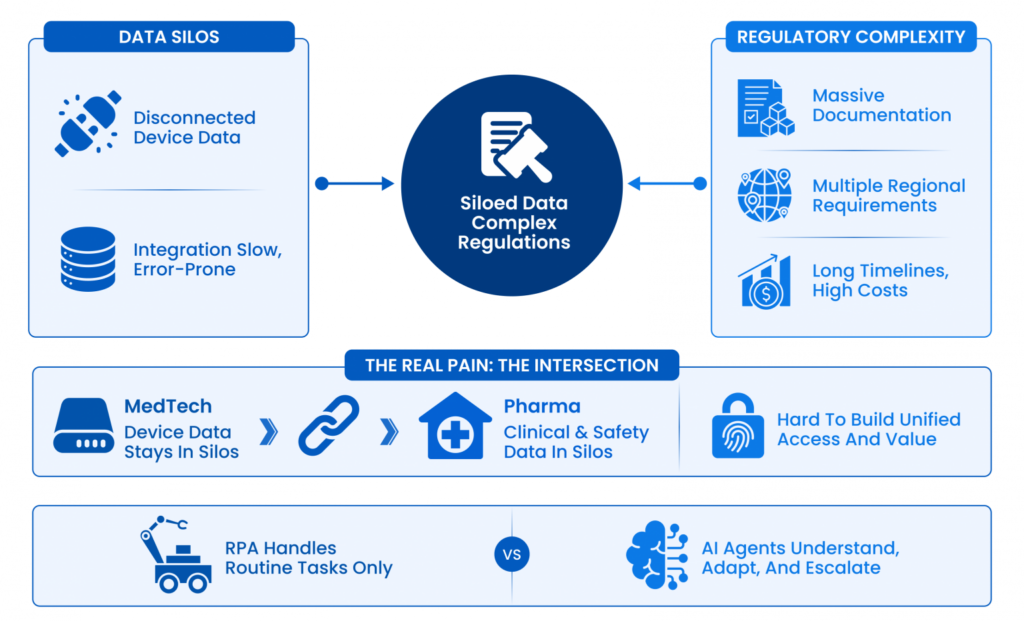
Medical device manufacturers face a data crisis. A typical hospital might deploy hundreds of connected devices, such as infusion pumps, monitors, and ventilators, each producing terabytes of information daily in proprietary formats. Integrating this data across vendors for post-market surveillance or FDA submissions often means weeks of manual effort, with error rates that can reach 10-15%.
Pharma companies encounter similar bottlenecks. Preparing a New Drug Application (NDA) or Biologics License Application (BLA) can involve organizing hundreds of thousands of pages from clinical trials, manufacturing records, and stability studies. Regional differences, for instance, FDA vs. EMA vs. CDSCO, add layers of reformatting and cross-referencing, often stretching timelines to 12-18 months and costing millions per submission.
The challenge is that MedTech’s real-time device data rarely flows seamlessly into Pharma’s clinical and pharmacovigilance systems. Market access teams then struggle to build unified health economics cases or reimbursement dossiers. Traditional Robotic Process Automation (RPA) helps with repetitive tasks but falters on ambiguous data, complex reasoning, or unexpected scenarios.
AI agents address these gaps by combining large language models with tool-use capabilities and adaptive reasoning. Unlike rigid scripts, they can ingest unstructured reports, harmonize datasets, interpret regulatory intent, and propose solutions by escalating critical decisions to humans.
How AI Agents Deliver Impact in MedTech
Consider a cardiac device manufacturer dealing with multiple platforms. Previously, monthly adverse event analysis across devices took 120 analyst hours. An AI agent, connected to device APIs, the FDA’s FAERS database, and internal quality systems, now harmonizes data, spots emerging safety signals, and drafts investigation hypotheses. The result? Processing time drops to about 8 hours, with faster signal detection and far fewer errors.
Another common win is that it can manage compliance across 80+ countries. Regional rules for labeling, claims, and surveillance vary widely. An agent can scan device master records against databases for FDA, EMA, NMPA, CDSCO, and PMDA requirements, flag mismatches, and generate tailored dossiers. Companies report audit findings dropping sharply and new market entries speeding up by 30-40%.
For real-world evidence, agents integrate EMR data via FHIR standards, apply clinical criteria intelligently (handling missing values), and synthesize findings for health economics submissions. This shortens aggregation from months to weeks while improving dossier quality.
Agentic AI Breakthrough in Pharma Operations and Market Access
In drug development, AI agents shine during regulatory document assembly. One oncology NDA involved 250,000+ documents. An agent structured them in accordance with the Common Technical Document (CTD) format, identified inconsistencies, drafted summary sections, and flagged potential deficiencies. Assembly time fell dramatically from 18 months to roughly 4 months, with most verification shifting to human oversight for high-stakes sections.
Regional adaptation becomes faster, too. Starting from a US approval, an agent can restructure narratives for EMA’s preference for detailed clinical stories or CDSCO’s focus on manufacturing, while adapting benefit-risk discussions to local priorities. This enables more simultaneous filings and gets medicines to patients earlier.
Pharmacovigilance benefits from continuous monitoring. Agents pull from EHRs, claims, literature, and registries to detect signals, apply causality algorithms (like Naranjo or WHO-UMC), and prepare preliminary reports. Manual review drops significantly, and genuine risks surface weeks earlier.
Here’s a quick comparison of traditional vs. agent-assisted workflows:
| Process Area | Traditional Approach | AI Agent Approach | Typical Improvement |
|---|---|---|---|
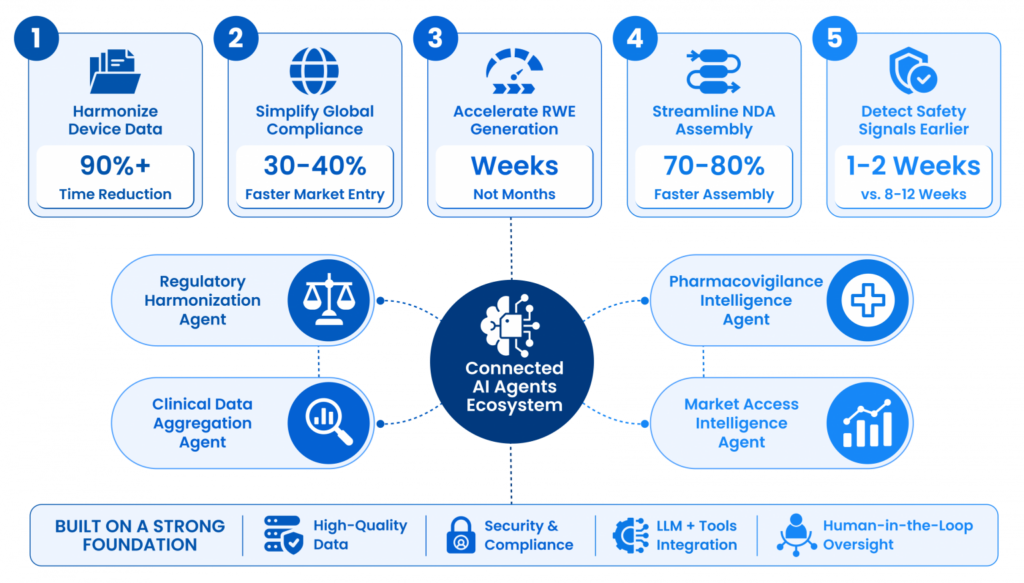
| Device Data Harmonization | Manual extraction & reformatting | Automated schema mapping + analysis | 90%+ time reduction |
| NDA/BLA Assembly | 12-18 months, heavy manual checks | Structured drafting with validation | 70-80% faster, fewer resubmissions |
| Regional Adaptation | 6-9 months per region | Context-aware restructuring | 2-3 months, lower cost |
| Pharmacovigilance Signals | Manual review of thousands of reports | Anomaly detection + causality assessment | 1-2 weeks vs. 8-12 weeks |
The Power of Connected Agent Ecosystems
Isolated agents help, but the biggest gains come from the orchestration of agents that communicate. In a companion diagnostic + therapeutic scenario, a Regulatory Harmonization Agent tracks dependencies between device and drug approvals, while a Clinical Data Aggregation Agent ensures consistency across sources. A Market Access Intelligence Agent monitors reimbursement shifts and flags implications.
This multi-agent setup supports parallel workflows instead of sequential handoffs, reducing duplication and misalignment. Technical architecture typically includes an LLM core for reasoning, tool integration for APIs and databases, persistent memory for context, robust guardrails for compliance (HIPAA, GxP), and human-in-the-loop escalation.
Data quality remains foundational, and agents thrive on standardized formats like FHIR or HL7 and strong governance. Many organizations discover that preparing for AI forces welcome improvements in their data infrastructure.
Implementation Best Practices and Challenges
Successful deployments start small with a well-defined pilot, such as reducing NDA dossier assembly time by 50%. Choose areas with good data access, clear metrics, and cross-functional support. Begin with supervised modes (full human review), then move to exception-based oversight as trust builds.
Key success factors include:
- Strong change management: Retrain teams to shift from data entry to validation and strategy.
- Immutable audit trails: Every agent decision must be traceable for inspections.
- Transparent validation: Cross-check outputs against source documents to mitigate risks.
Despite significant progress, legacy systems and organizational silos continue to pose real hurdles for AI implementation in regulated environments. Integrating these technologies often demands substantial upfront work to bridge disconnected data sources and workflows. Yet the regulatory landscape is evolving to provide much-needed clarity and structure.
In early 2026, the FDA and EMA released joint guiding principles for AI in life sciences, underscoring the importance of reliability, transparency, human oversight, and strict adherence to GxP standards. A core message from regulators is clear: AI tools must support decision-making processes rather than replace the fundamental accountability that rests with sponsors. This emphasis on human-centric governance helps address one of the most persistent technical challenges, like model hallucinations, where systems generate confident but incorrect outputs. Mitigating this risk requires robust, layered fact-checking protocols and careful validation frameworks.
Workforce concerns are equally important. Rather than framing AI agents as job replacements, forward-thinking organizations are positioning them as powerful tools that eliminate repetitive, low-value tasks. This approach allows skilled professionals to focus on higher-order expertise, strategic judgment, and complex problem-solving, ultimately enhancing job satisfaction and productivity.
Investment and Returns
The financial case for AI adoption, while requiring careful planning, is increasingly compelling. Initial investments include covering data preparation, model development, integration, and ongoing maintenance, and can range from hundreds of thousands to low millions of dollars. However, many organizations are seeing strong returns on investment from 18 to 36 months through accelerated regulatory approvals, reduced errors, and more efficient resource allocation.
This momentum is reflected in the market, that is, venture investment in healthcare AI agents surged in 2025, with particularly strong interest in regulatory intelligence and real-world evidence (RWE) applications. Such capital inflow signals growing confidence in the sector’s long-term potential.
Looking Ahead: 2026 and Beyond
Specialized medical LLMs trained on regulatory and clinical corpora are gaining traction for higher accuracy. But multi-agent systems can handle end-to-end orchestration, while real-time clinical decision support integrating device data and guidelines moves from pilot to phased rollout. Regulators are expected to release more detailed AI frameworks later in 2026-2027, reducing uncertainty.
For MedTech leaders, faster evidence generation strengthens reimbursement cases. For Pharma, compressed timelines improve economics and patient access. Early adopters may hold an 18-24 month edge before capabilities become more widespread.
Next Steps for Your Organization
- Audit your biggest regulatory or data pain points and define success metrics clearly.
- Assess data readiness and check if agents securely access the needed systems.
- Start with a focused pilot and involve regulatory experts from day one.
- Invest in training and position the technology as an augmentation.
Author’s Note: This article was supported by AI-based research and writing, with Claude 4.5 assisting in the creation of text and images.
Author

Kavin Xavier is Vice President of AI Solutions at CapeStart, where he leads the development and deployment of AI-driven platforms since 2014. With over 10 years of experience in technology leadership, he previously held roles in technology and operations and worked as a project lead at Thomson Reuters and RedEgg Solutions. Kavin holds a Bachelor’s degree in Computer Science from Anna University, and is passionate about leveraging emerging technologies, including .NET, Java, SQL, and GenAI, to drive innovative, scalable solutions for life sciences and enterprise clients.
FAQ
How are AI agents bridging MedTech data and Pharma market access?
They reason, adapt, and use tools to harmonize device data with clinical systems, accelerating safety monitoring and market access.
What core challenges do AI agents solve in MedTech and Pharma?
They eliminate data fragmentation from connected devices and streamline complex, proprietary data formats for regulatory submissions.
How do AI agents accelerate drug and device submissions across global regions (FDA, EMA, CDSCO)?
They structure documents into the CTD format, detect inconsistencies, and rapidly adapt narratives for regional rules, cutting timelines by 70-80%.
What role do AI agents play in generating Real-World Evidence (RWE)?
Agents integrate EMR/FHIR data, apply clinical criteria, and synthesize findings for high-quality health economics and reimbursement dossiers in weeks.
How do AI agents enhance pharmacovigilance and post-market safety?
They continuously pull data from diverse sources (EHRs, literature) to detect safety signals, apply causality algorithms, and draft reports faster than manual review.
What is the biggest advantage of connected, multi-AI agent ecosystems?
They support parallel workflows and track dependencies between approvals (e.g., companion diagnostics/therapeutics), reducing duplication and misalignment.
What regulatory guidance exists for AI agents regarding compliance (GxP, Human Oversight)?
Success requires firm audit trails, transparent validation, and adherence to joint FDA/EMA principles for reliability and human oversight.