Introduction: When Simple If-Else Logic Becomes Complex
Most software starts with simple business rules, easily handled with a handful of if-else statements. But as a product scales, requirements snowball: new promotions, compliance tweaks, and shifting user segments pile on more logic. Eventually, shipping a minor change such as adjusting a discount or updating eligibility means risking the stability of your codebase. If you’ve ever feared modifying conditional logic, you’re not alone.
Enter the rule engine: a specialized system designed to pull business rules out of your application code, making them easier to manage, change, and audit.
What Is a Rule Engine?
A Rule Engine is a specialized software component that acts as a sophisticated, external inference engine. Its core function is to separate business rules from the application’s process flow.
The process is simple:
- Input: Your application gathers data (the “facts,” e.g., a customer’s loyalty tier, an order total).
- Evaluation: It feeds these facts to the Rule Engine.
- Output: The engine evaluates the facts against a set of independent rules and returns a decision.
The rules themselves follow the classic IF-THEN structure, known as production rules:
- Condition (The “IF” side): The patterns that must be matched against the input data.
- Example: IF customer.tier = ‘GOLD’ AND order.total > 100
- Action (The “THEN” side): The operation(s) to execute when the conditions are met.
- Example: THEN apply 15% discount AND notify manager
This fundamental decoupling transforms business logic from scattered code fragments into manageable, version-controlled assets.
Why Use a Rule Engine? Real-World Advantages
Rule engines excel in scenarios where rules are both crucial and frequently change.
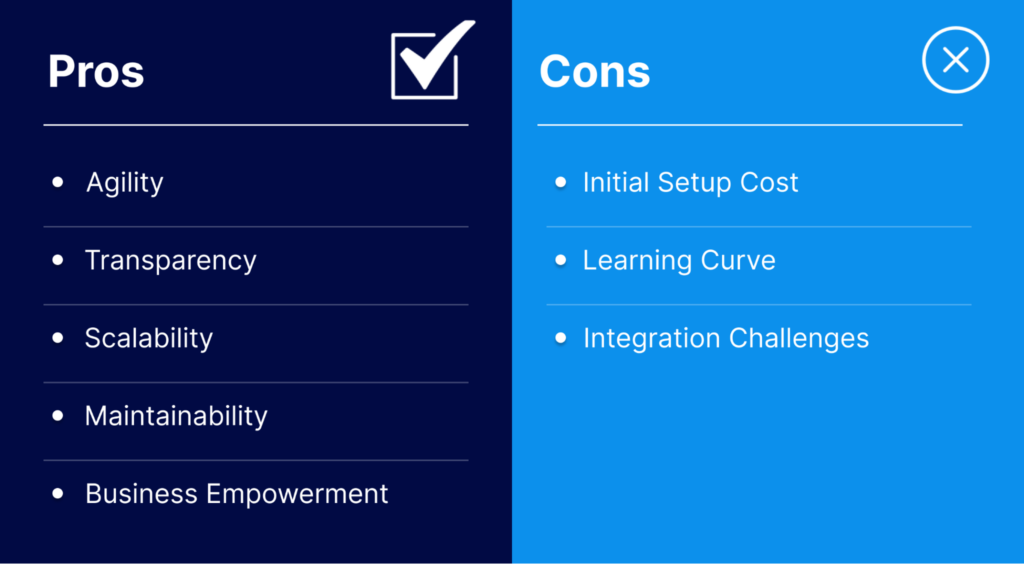
- Agile Business Changes: Business experts can update policies themselves, drastically shortening the time from decision to deployment.
- Easier Maintenance: You can avoid code littered with complex conditionals. Instead, the app code collects the facts, and the rule engine chooses the outcome.
- Transparency: Each decision is traceable, which is essential for compliance-intensive fields.
- Scalable Rule Management: Handling 200+ rules? No problem. Rule engines thrive here, while procedural code crumbles.
Example Scenario:
A fintech startup regularly updates its loan eligibility criteria. With a rule engine, compliance teams roll out changes instantly, with minimal developer intervention.
Trade-offs and Implementation Considerations
While rule engines provide business agility, they introduce their own engineering challenges:
- Performance: Evaluation at runtime is slower than hard-coded logic, potentially a dealbreaker in latency-critical systems.
- Learning Curve: Teams must master new rule formats, APIs, and testing patterns.
- Debugging: Tracing through dozens of rules is harder than following a stack trace.
- Rule Sprawl: Without governance, your rule repository can become a tangled mess, just like the one you wanted to escape.
When Should You Use a Rule Engine?
Consider a rule engine when your application’s logic is:
- Constantly Evolving: Changing frequently due to market shifts, regulations, or business strategies.
- Inherently Complex: Involves numerous nested conditions and potential outcomes.
- Business-Driven: Defined and modified by non-technical experts who need autonomy.
Think about these common scenarios:
- Fraud Detection: Spotting suspicious transactions based on evolving patterns. (e.g., Identifying fraudulent credit card transactions based on location, amount, and time of day)
- Insurance Underwriting: Evaluating applications based on complex policy criteria. (e.g., Determining insurance premiums based on age, driving record, and vehicle type)
- E-commerce Personalization: Tailoring pricing, discounts, and shipping options. (e.g., Displaying personalized product recommendations based on browsing history and past purchases)
- Medical Decision Support: Recommending treatments based on patient data and medical guidelines. For example, alerting doctors to potential drug interactions based on a patient’s medical history.
The Impact: Rule Engine vs. Traditional Approach
| Aspect | Traditional Approach (Hard-coded Logic) | Rule Engine Approach | Impact Analysis |
|---|
| Change Management | Requires code changes, testing, and deployment cycles (weeks) | Business users update rules via UI/configuration (hours) | 10x faster adaptation to market changes |
| Business Ownership | Developers act as intermediaries for all logic changes | Domain experts directly manage business rules | Eliminates translation errors and reduces dependency on IT |
| Complexity Scaling | Nested if-else statements become unmaintainable beyond 10–20 conditions | Rules remain manageable even with 1000+ conditions | Scalable to enterprise-level complexity |
| Audit & Compliance | Logic scattered across codebase; hard to trace decisions | Complete audit trail with versioned rules | Regulatory compliance becomes straightforward |
| Testing Impact | Full regression testing needed for any logic change | Isolated rule testing with immediate validation | 80% reduction in testing overhead |
| Error Rate | High risk of introducing bugs when modifying complex conditionals | Rules validated independently; changes are localized | Significantly lower production incidents |
| Team Productivity | Developers modifying business logic instead of core features | Developers focus on platform capabilities | 2–3x improvement in feature delivery |
A Landscape of Popular Frameworks
The ecosystem is rich, offering options for various stacks:
- For Java/JVM:
- Drools: The powerful, open-source industry leader ideal for large enterprises.
- Easy Rules: A lighter, simpler choice for more modest rule workloads.
- For .NET Stack:
- NRules: A mature, open-source production rules engine, inspired by Drools.
- For Python & JavaScript:
- Durable Rules: Supports defining complex, multi-language rule sets in code.
- JSON Rules Engine: Excellent for rules managed via JSON, facilitating headless rule editing and storage.
- Enterprise & Standards:
- IBM ODM (Operational Decision Manager): An enterprise-grade commercial suite for large-scale integration.
- DMN (Decision Model and Notation): A vendor-neutral standard for modeling and executing decisions (supported by tools like Camunda).
Conclusion: Embracing Change with Rule Engines
Modern, competitive businesses can’t afford rigid, hard-coded decisions. A rule engine is a strategic investment that treats business logic as a first-class, managed resource.
By adopting a rule engine, you treat business logic as a living, managed entity for unleashing agility, maintainability, and auditability at scale. For teams facing the daily pain of ever-changing conditional code, moving to a rule engine could be the transformation that unlocks rapid innovation and resilient architecture.
Before leaping into rule engines, start with process mapping and a rules inventory. This sets your team up for smoother adoption and quicker ROI.

 Venkatesh S