

Vibe Coding vs. Vibe Engineering
Vibe coding is an exploratory development approach where developers use AI tools, intuition, and rapid iteration to build working solutions quickly. For example, a startup founder uses AI tools to build a customer support chatbot in a weekend. The code works, customers like it, and the product gets initial traction.
Vibe engineering begins when the solution becomes important enough that reliability matters more than speed alone. For example, that same chatbot now serves 100,00 customers, integrates with CRM systems, handles sensitive data, and must maintain 99.9% uptime. The team introduces logging, monitoring, testing, governance, and operational controls.
What is the difference between vibe coding and vibe engineering? Learn how modern software teams evolve from rapid experimentation to enterprise-grade systems without drowning in technical debt or sliding into technical bankruptcy.
Every Software Product Hits This Moment
The demo worked. Early users showed up, and the momentum built. And then something subtle changed.
A feature that should take a day stretches into two weeks. A new engineer asks, “Why is this built like this?” The most honest answer is often, “It just evolved.“
If you have built software long enough, you have probably felt this, perhaps more than once. This is not a story about poor engineering or careless teams. It is about phases, how products are born, how they survive, and how some of them learn to endure at scale.
Vibe Coding vs Vibe Engineering: The Two Models
At the center are two modes of building that most teams go through, whether they name them or not: vibe coding and vibe engineering. They are not opposites – just show up at different stages of the journey.
The real failure is not choosing one over the other. It is staying in the wrong mode for too long.
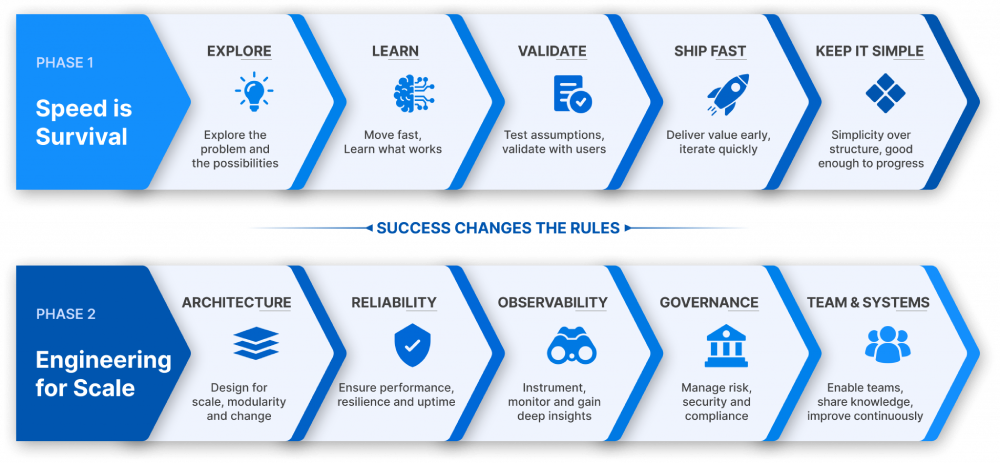
Phase 1: When Speed Is Survival
In the early stage of a product, structure is expensive. You are not optimizing for elegance or long-term scalability. You are focusing on validation. Does the idea work? Do users care? Is the problem important enough to continue?
In this phase, architecture emerges organically, and the edge cases are not ignored but postponed. Shared understanding lives in conversations rather than documentation. This is vibe coding, and in many cases, it is the reason the product exists at all.
Vibe coding thrives when:
- You are exploring a problem, not formalizing it
- Learning matters more than correctness
- Rewriting later is acceptable
- The system fits within a few minds
- Time to market outweighs system elegance
Many successful startups reached product–market fit because they moved quickly instead of over-engineering early. Spending months designing a perfect system before confirming demand is often how teams build the wrong solution effectively.
But speed always leaves fingerprints. You just don’t notice them at first.
Phase 2: When Success Changes the Rules
Success rarely comes with an announcement. It grows quietly.
Usage increases. Revenue begins to depend on yesterday’s architectural decisions. A temporary workaround becomes critical infrastructure. New engineers join and do not share the original mental model.
The central question shifts. Early on, the question is: Can we make this work? Later, it becomes: Can we live with this decision for the next two years?
This is usually the moment where vibe engineering has to start. Vibe engineering does not eliminate intuition, it disciplines it. Experience comes into play not just for delivering features but for anticipating failure modes, understanding operational reality, managing compliance risks, and supporting team growth. The vibe does not disappear. It matures.
Exploration vs Ownership: The Real Difference
The distinction between vibe coding and vibe engineering is not primarily technical. It is psychological. The difference appears in the questions people ask in meetings.
| Vibe Coding Mindset | Vibe Engineering Mindset |
|---|---|
| Let us see if this idea holds | Someone else will maintain this |
| We can clean this up later | This will break at 2 a.m. |
| I understand how this works | We will not remember why this exists in six months |
Neither mindset is wrong. Each is appropriate at a specific stage. Problems begin when teams remain in exploration mode long after they have crossed into ownership territory, when real users, revenue, service level agreements, and on-call rotations are already in place.
The Speed Illusion
Vibe coding feels faster. In the short term, it often genuinely is. You can ship a minimum viable product (MVP) faster than it takes to conduct a formal design review. But speed depends on what you measure.
Vibe coding focuses on time to first deploy. Vibe engineering focuses on the time to stable scale. These are not the same goals. Many teams quickly find product-market fit and then spend the next year rewiring core systems because the original foundation can’t support team growth, feature expansion, or compliance needs. That isn’t ordinary technical debt; it’s sometimes called technical bankruptcy—the point where the cost of change exceeds the system’s current value.
You know you have reached this point when:
- Simple changes take weeks instead of days
- Deployments create anxiety
- Production incidents become routine
- New engineers struggle to contribute independently
- Senior engineers spend more time firefighting than building
Technically, this usually means implicit data contracts, synchronous service chains without resilience patterns, and limited isolation between domains. A small schema change or API tweak can cascade across the system because boundaries were never explicitly enforced.
The core problem is not messy code. It is accumulated uncertainty. When system behavior is unpredictable, teams compensate with caution, rework, and firefighting. Velocity drops not because engineers are slower, but because confidence is lower.
At that stage, the organization is no longer moving fast. It is moving expensively.
Vibe Coding vs. Vibe Engineering: Invisible Risk
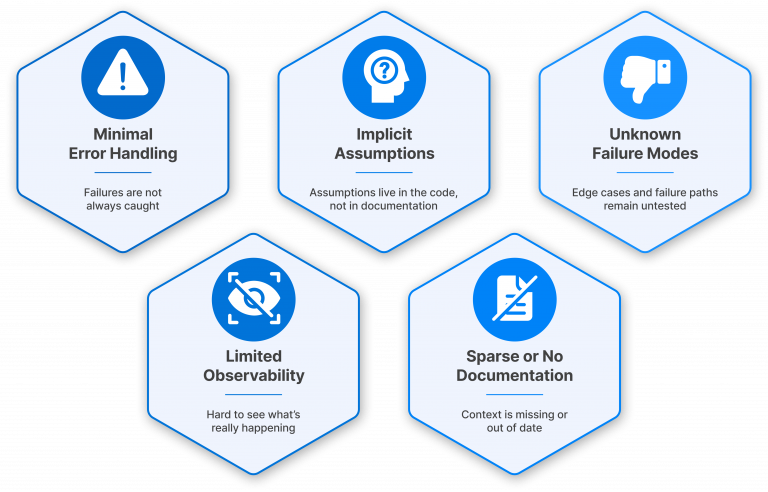
Early-stage systems are optimistic by necessity. Error handling is minimal. Observability is limited. Assumptions remain implicit in the code, undocumented and untested. Documentation is either sparse or nonexistent.
During exploration, that is often acceptable. However, during ownership, it becomes risky. Vibe engineering does not eliminate risk. It makes risk explicit. Teams operating in this mode usually ask the following questions.
- What happens if this fails?
- What happens if traffic doubles?
- What happens if a key engineer leaves?
- What happens if compliance requirements tighten?
When failures occur in mature vibe-engineered systems, they are rarely surprising because someone has already modeled the failure mode and documented it. The difference is not perfection. It is awareness.
Scaling Is a People Problem, Not a System Problem
Scalability is often seen as a technical challenge. In practice, the scaling problem is a human one. Vibe-coded systems often scale technically before they scale socially. Knowledge becomes tribal. Progress depends on a few individuals who “just know how it works.”
Vibe engineering is fundamentally about scaling teams, not just systems. Clear service boundaries reduce cognitive load. Predictable patterns shorten onboarding time from months to weeks. Robust observability reduces operational fear, which reduces burnout. Well-documented decisions preserve institutional memory across team transitions. Defined ownership prevents the diffusion of responsibility that causes production incidents to become everyone’s emergency.
This does not require perfect architecture diagrams or exhaustive documentation. It requires thinking about the next engineer who will read this code—who might be you, six months from now, looking at your own decisions with no memory of why you made them.
When Should You Transition?
The shift from vibe coding to vibe engineering is rarely dramatic in the moment. Most teams do not notice it during a meeting or a sprint. They feel it in friction, in latency, in morale, long before they name it.
The following signals, especially when combined, indicate that the transition is not just appropriate but overdue:
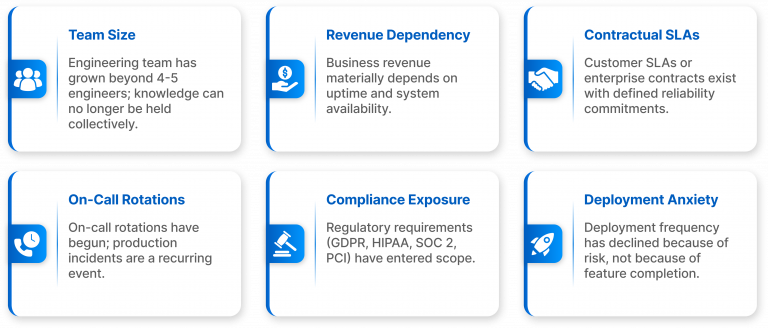
If several of these signals apply at once, the transition is not just timely—it is likely already late, and the cost of delay is compounding daily.
How to Transition Without Killing Momentum
Moving toward vibe engineering means adding structure precisely where it adds value, not everywhere uniformly. The following sequencing has proven effective across multiple engineering organizations that have navigated this transition successfully:
| Step | Action | Why It Matters |
|---|---|---|
| 01 – Intent | Lightweight architecture reviews to clarify design intent | Surfaces hidden assumptions before they become burdensome debt |
| 02 – Reliability | Define and enforce standards for logging, monitoring, and error handling | Enables detection before customers report failures |
| 03 – Ownership | Assign clear ownership boundaries across services and domains | Eliminates “nobody’s problem” failure modes during incidents |
| 04 – Memory | Document key decisions and their rationale (ADRs) | Preserve institutional memory across team transitions |
| 05 – Visibility | Invest in observability like tracing, metrics, dashboards, and runbooks | Converts operational fear into operational confidence |
| 06 – Capacity | Model failure modes for critical paths under load | Reveals capacity limits before they become production incidents |
This is not a waterfall transformation. It is a gradual layering of maturity over an existing codebase, prioritized by operational risk and business criticality. The goal is not to slow down innovation. The goal is to protect it, that is, to ensure that the speed you invested in building is not consumed by the problems you failed to manage.
The Mistake Most Teams Make
Most teams do not fail because they practice vibe coding, they fail because they never stop. They keep optimizing for speed long after the system requires intentional design. They confuse familiarity with maintainability and activity with progress.
Strong teams recognize when to shift gears. They protect early experimentation and invest deliberately in reliability as the stakes increase. They do not wait for outages, burnout, or large-scale rewrites to force maturity.
Why This Matters for the Future of Software Teams
Software systems today are more connected, data-heavy, and often layered with AI-driven workflows. That means unclear architecture doesn’t just create small inconveniences, it multiplies complexity over time. What used to be a simple feature platform slowly turns into an operational ecosystem, whether we planned for it or not.
The teams that win aren’t just the ones that start fast. They’re the ones that know when to stop experimenting and start committing, and fix their systems before growth makes the decision for them.
Closing Thoughts
Vibe coding brings you to something real. Vibe engineering ensures it remains real at scale. Neither mode is a permanent destination. The best engineering organizations seamlessly alternate between them, shifting back into exploration mode for new product surfaces while maintaining engineering discipline in their production core.
This is rarely about intelligence, tooling, or raw talent. It is about timing and the organizational awareness to recognize when the landscape has shifted. The teams that scale without collapsing are those that treat this recognition not as an admission of past failure, but as one of the most sophisticated engineering decisions they can make.
Author’s Note: This article was supported by AI-based research and writing, with Claude 4.5 assisting in the creation of text and images.
Author

Vinoji is a technology and business professional with expertise in project execution, stakeholder management, and cross-functional collaboration. As a Project Manager, he works closely with clients and internal teams to drive successful project outcomes, ensuring solutions are delivered with quality, clarity, and measurable impact.
FAQ
What is the main difference between Vibe Coding and Vibe Engineering?
Think of Vibe Coding as the “exploration” phase, it’s all about speed, intuition, and getting an idea off the ground to see if it works. Vibe Engineering is the “maturity” phase. It’s when your product is successful enough that you need to shift your focus from “getting it to work” to “keeping it running reliably” for your users.
How do I know when it’s time to switch from Vibe Coding to Vibe Engineering?
You don’t usually need a formal meeting to decide this; you’ll feel it. The signs are in the friction: if simple updates are taking way longer than they used to, your team is spending more time “firefighting” bugs than building features, or new team members seem confused about how things work, it’s a clear signal that it’s time to evolve your process.
Is Vibe Coding "bad" for a startup?
Not at all! In fact, Vibe Coding is often how the best products are born. You need that initial burst of speed to validate your idea. The problem isn’t the Vibe Coding itself—it’s staying in that mode long after your product has outgrown it. Scaling requires a different mindset.
Why do you say scaling is a "people problem" rather than a "system problem"?
Because code doesn’t get burnt out or confused, as people do. Vibe Engineering isn’t just about adding more monitoring or tests; it’s about making things predictable for the humans on your team. Clear ownership, documentation, and simple patterns reduce the “operational fear” that causes burnout and helps your team scale without collapsing.
Will adding structure like Vibe Engineering slow down my team’s progress?
It only slows you down if you try to do everything at once. The goal isn’t to kill your momentum; it’s to protect it. By layering in structure like defining clear ownership or improving error handling, you’re actually buying back the time you would have otherwise spent cleaning up messes or fixing recurring outages later.