

The Operator Era in Pharma has arrived. Artificial intelligence is no longer limited to answering questions or generating drafts. It is beginning to execute real work across pharmaceutical organizations. From screening thousands of research papers and assembling HEOR dossiers to supporting clinical operations and quality processes, AI operators are taking on repetitive, evidence-intensive tasks while experts focus on oversight, scientific judgment, and strategic decisions. This shift is changing not just how work gets done, but how pharma teams are designed.
Unlike traditional AI assistants that respond to individual prompts, AI operators can plan, coordinate, and complete end-to-end workflows within defined guardrails. For an industry built on precision, compliance, and trust, this represents a fundamental change in operating models rather than just another technology upgrade. This white paper explores what the Operator Era in Pharma really means, where it is already delivering value, the governance required to deploy it responsibly, and why human expertise remains at the center of every critical decision.
From Copilot to Operator: The Operator Era in Pharma
Pharma has long used computational models for drug discovery and data analysis. The leap to agentic AI systems that reason, plan, and act autonomously within guardrails marks a new chapter
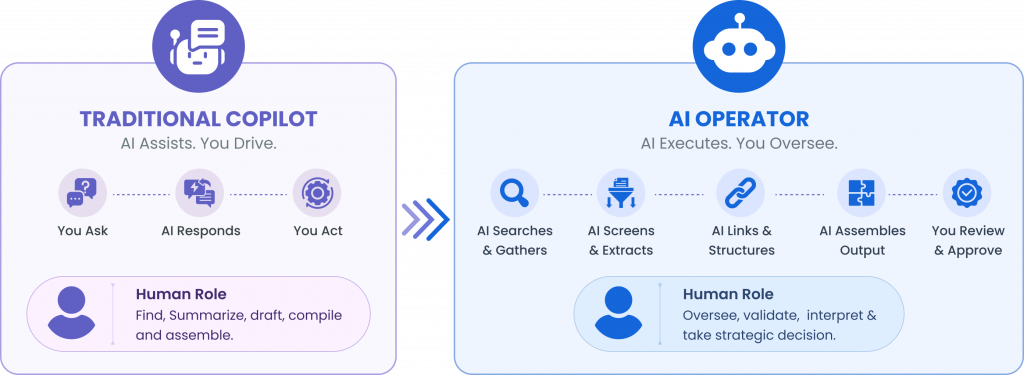
Traditional AI analyzed data and offered recommendations. Agentic operators go further: they coordinate workflows, draft documents, monitor processes in real time, flag deviations, and even suggest corrective actions. Think of an AI copilot on the factory floor that answers an operator’s voice query at 2 a.m. with a cited SOP reference, or systems that autonomously optimize batch records while ensuring GxP compliance.
Why now? Better data infrastructure, mature large language models, domain-specific fine-tuning, and regulatory progress like FDA and EMA guidance on AI in GMP have converged.
What Real Work Looks Like: AI Operators Inside the Pharma Workflow
A side-by-side comparison clearly highlights the differences between the two AI-assisted evidence synthesis models. The table below compares how a typical evidence-related task looked before and after the shift to an operator model.
| Task | Traditional Copilot Approach | AI Operator Approach |
|---|---|---|
| Literature screening | Human searches, AI summarizes results on request | AI searches, screens, and tags studies against criteria automatically |
| Data extraction | Human reads each paper and enters data manually | AI extracts endpoints, doses, and outcomes directly into structured tables |
| HEOR dossier drafting | AI drafts a paragraph when prompted, human assembles the report | AI assembles the full dossier draft, linked to source citations |
| Medical information requestsI | Human researches and writes each response individually | AI drafts response, links evidence, and routes for pharmacist sign-off |
| Trial data QC | Human manually cross-checks entries against source documents | AI flags inconsistencies and traces every value back to its source |
Notice the pattern. In every row, the human role moves from producer to reviewer. That is not a loss of oversight, since a person still signs off on the final output. Instead, it is a redistribution of effort toward judgment and away from repetitive assembly work. As a result, teams can handle a larger evidence base without growing headcount at the same rate.
Operator Era in Pharma: The Five-Stage Pipeline
An AI operator does not simply “read and answer.” It runs through a structured pipeline so that every output stays traceable, which matters enormously in a regulated industry. The infographic below breaks down the five stages that typically sit behind an AI operator handling evidence synthesis or clinical trial data.

Data ingestion: Trial registries, journal articles, and internal documents enter the system in whatever format they arrive in, whether that is a PDF, a structured feed, or a scanned report.
Extraction: The operator identifies and extracts key information such as study endpoints, patient populations, interventions, dosing, and outcomes. This converts unstructured content into structured, analysis-ready data.
Entity resolution: Because the same drug, trial, or author can appear under different names across sources, the system deduplicates and reconciles these entities so nothing gets double-counted.
Source Linkage: Every extracted data point remains linked to its original sentence, table, or document. This ensures complete traceability, allowing reviewers to quickly verify evidence and support regulatory compliance.
Validation and compliance: A human reviewer checks the output against the audit trail before it moves forward, keeping the process aligned with GxP-style documentation expectations.This pipeline is what separates a reliable AI operator from a chatbot that happens to sound confident. Without source linkage and an audit trail, an AI-generated summary is not usable in a regulatory context, no matter how well written it is.
How the Operator Era in Pharma Is Moving Into Real Workflows
The operator model is not theoretical. It is already running inside evidence-heavy pharma functions, and each function has its own flavor of “real work” being handed off.
| Function | What the Operator Handles | Where the Human Is In Charge |
|---|---|---|
| Quick Research | Rapid literature pulls for internal questions | Deciding which findings go into strategy documents |
| Systematic Literature Review | Screening, extraction, and PRISMA-aligned tracking | Final inclusion and exclusion judgment calls |
| HEOR and HTA Dossiers | Assembling GRADE-aligned evidence tables | Interpreting clinical significance for payers |
| Medical Information Requests | Drafting evidence-linked responses to HCP queries | Pharmacovigilance and medical sign-off |
| Value Dossiers | Structuring comparative effectiveness data | Positioning and market access strategy |
| Social Media Listening | Aggregating and tagging public sentiment signals | Deciding what warrants a formal response |
| MedTech Dossiers | Compiling device performance and safety evidence | Regulatory strategy and submission timing |
| Joint Clinical Assessments (JCA) | Cross-referencing evidence against EU JCA requirements | Country-level adaptation and final approval |
Interestingly, the common thread across every row is that the operator absorbs the volume, while the human absorbs the risk. That balance is exactly what regulators and internal compliance teams want to see, since it keeps accountability with a licensed, accountable person even as throughput increases.
Governance First: Why Trust Still Runs the Show
None of this works without governance, and pharma teams know that better than most industries. An AI operator that cannot show its sources is not an asset, it is a liability waiting to surface during an audit. That is why the strongest implementations pair operator-level automation with strict, exportable audit trails.
The FDA has already begun publishing guidance on how AI-supported tools should be evaluated across the drug development lifecycle (FDA on AI in drug development), and organizations such as ISPOR continue to shape best practices for evidence quality in HEOR and HTA submissions (ISPOR). Meanwhile, industry bodies like PhRMA have highlighted the need for responsible AI adoption that keeps human accountability intact (PhRMA). The direction is consistent across all three: automation is welcome, but traceability is non-negotiable.This is also why validation cannot be an afterthought bolted onto the end of a project. Instead, it needs to be built into every stage of the pipeline described earlier, so that a reviewer is never asked to trust a number without seeing where it came from.
What the Operator Era Means for Pharma Teams
For teams evaluating this shift, the practical takeaway is straightforward. First, look for tools that show their work at every step, not just the final answer. Second, treat the AI operator as a member of the workflow that produces a draft, not as a replacement for the expert who approves it. Third, invest in training reviewers to check AI-assembled evidence efficiently, since reviewing well is a different skill than writing well.
The Operator Era in Pharma is not about replacing experts. It is about shifting their focus from repetitive, manual work to the decisions that truly require scientific expertise, clinical judgment, and regulatory accountability. As AI operators take on evidence-heavy workflows, success will depend on combining automation with transparency, governance, and meaningful human oversight.
Organizations that embrace this balance will be better positioned to improve productivity without compromising quality or compliance. The future of pharma belongs not to AI alone, but to teams where AI operators and human experts work together to deliver faster, more reliable outcomes.
Author’s Note: This article was supported by AI-based research and writing, with Claude 4.5 assisting in the creation of text and images.
Author

What is an AI operator in pharma?
An AI operator in pharma is a system that completes an evidence-related task end to end, such as screening literature or extracting trial data, rather than only answering questions when prompted. It produces a reviewable draft output instead of a conversational response.
How is an AI operator different from a copilot or chatbot?
A copilot responds to a single prompt and stops, leaving the human to assemble the final output. An AI operator carries a task through multiple steps, such as searching, extracting, and structuring data, before handing over a completed draft for human review.
Is AI replacing human reviewers in evidence synthesis and HEOR?
No, AI operators are not replacing human reviewers. They are shifting human effort away from manual data assembly and toward judgment, interpretation, and final sign-off, which remains a human responsibility in regulated pharma work.
How do pharma teams validate AI operator outputs for regulatory submissions?
Pharma teams validate AI operator outputs by checking the audit trail behind each extracted fact, confirming that every claim links back to its original source, and having a qualified reviewer approve the final draft before submission.
What tasks can AI operators handle in clinical trials and literature review?
AI operators can handle literature screening, data extraction from trial records, entity resolution across duplicate sources, and the initial assembly of evidence tables. Final interpretation and clinical judgment still sit with the human reviewer.
What are the risks of using AI operators in regulated pharma workflows?
The main risks include unverified data extraction, missing source traceability, and over-reliance on automated output without adequate human review. These risks are mitigated by requiring source linkage and validation at every pipeline stage.
How can pharma teams start adopting AI operators safely?
Pharma teams can start by piloting AI operators on lower-risk tasks such as quick research or internal literature scans, confirming that outputs include traceable sources, and gradually expanding scope as reviewers build confidence in the audit trail.