

When Prompts Become Production Infrastructure
Imagine you’re a medical researcher going through thousands of clinical papers to synthesize evidence on a new heart drug. In the past, you’d hardcode logic into software to parse those PDFs, which is a brittle, time-consuming process. But what if you could configure the AI’s “brain” on the fly, just by tweaking a prompt? That’s the promise of an Enterprise-Grade AI System in the enterprise era, where we’ve shifted from experimentation to robust, production-ready systems. No fine-tuning needed; you need to do smart configuration. In this post, we’ll explore how to build Enterprise-Grade AI Systems, drawing from real-world applications in systematic literature reviews (SLR) but applicable to any high-stakes AI workflow.
The Transformation: From Experimentation to Configuration
In the early stages of LLM adoption, prompting was viewed as an “art”—an experimental process of trial and error. As we move into large-scale enterprise deployments, this paradigm has shifted fundamentally. Every Enterprise-Grade AI System ensures that prompts are no longer just strings; they are the runtime configuration of the intelligence tier. Learn more about OpenAI Prompt Engineering Best Practices.
Intelligence Tier vs. Logic Tier in an Enterprise-Grade AI System
In traditional medical software, systematic reviews required hardcoded logic for parsing PDFs. In the “Prompt-to-Production” era, we decouple reasoning from execution. This allows medical researchers to update the extraction criteria, that is, the prompt, without redeploying the platform.
Prompt Frameworks as API Contracts
In a medical production environment, a prompt serves as an API Contract.
- Determinism vs. Flexibility: We substitute the model’s creative “unpredictability” for structural “reliability”, for example, ensuring a 100% success rate in identifying ‘Adverse Events’.
- Failure Isolation: Production systems utilize Fallback Prompts. If a complex PICO extractor fails to parse, the system catches the exception and routes to a simpler “Abstract Classifier” to maintain service.
- Observability: Every SLR prompt call must emit telemetry: prompt_version_id, extraction_accuracy_score, and token_usage.
Enterprise Prompt Frameworks
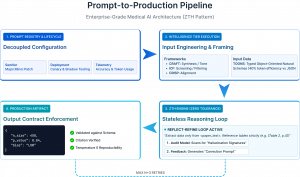
The shift from experimental prompting to production engineering required a move away from a single, universal prompt to a diverse, specialized toolset. As prompts evolved into the runtime configuration of the intelligence tier, it is important to develop distinct, purpose-built structures to manage the complexity and varied needs of clinical workflows. The following enterprise prompt frameworks represent this necessary taxonomy, enabling teams to choose the best design for tasks ranging from high-volume screening to high-quality evidence synthesis.
| Framework Name | Medical Use Case | Prompt Structure | Example Snippet |
|---|---|---|---|
| 1. CRISP | Review Alignment | Context, Role, Intent, Subject, Purpose | “Act as a Medical Librarian (Role)…” |
| 2. CRAFT | Evidence Synthesis | Context, Role, Action, Format, Target | See Section 3.1 for details. |
| 3. RCI | Bias Checking | Recursive Criticism and Improvement | “Find 3 missing risks in your summary.” |
| 4. ICF | Screening | Information, Context, Filter | See Section 3.2 for details. |
| 5. SCQA | Clinical Questioning | Situation, Complication, Question, Answer | “Drug X is effective (S), but toxic (C)…” |
| 6. ReAct | Agentic Discovery | Reason + Act | “Thought: I need PubMed IDs. Action: Search…” |
| 7. Controlled CoT | Systematic Extraction | Step 1-N explicitly defined | “Step 1: Identify N. Step 2: Extract p-value.” |
| 8. Task Decomp. | Full Paper Analysis | Parent prompt + Sub-tasks | “Break methods and results into sub-tasks.” |
| 9. Schema-Driven | Data Entry | Schema-first enforcement | “Output strictly follows the CDISC JSON schema.” |
| 10. Policy-Const. | HIPAA Compliance | Global “never” instructions | “Never output Patient Identifiable Information.” |
| 11. Multi-Prompt | SLR Pipeline | Orchestrated sequence | “Screen -> Extract -> Risk of Bias -> Summary.” |
| 12. Prompt Router | Cost Efficiency | Semantic intent routing | “If intent=translation, use a smaller model.” |
Deep Dive: The CRAFT Framework
The CRAFT framework is designed for high-fidelity content generation where tone, expertise, and structural output are critical.
- Context: The situational backdrop (e.g., Phase III oncology trial results).
- Role: The professional persona (e.g., Clinical Data Scientist).
- Action: The specific verb-driven task (e.g., Synthesize adverse event data).
- Format: The technical structure (e.g., Tabular Markdown with statistical significance markers).
- Target: The specific audience (e.g., Regulatory Affairs team for FDA submission).
A Medical SLR (CRAFT) – Use Case
Context: We are conducting a systematic review of the efficacy of SGLT2 inhibitors in heart failure patients.
Role: You are a Senior Clinical Research Associate specialized in cardiology.
Action: Summarize the “Secondary Outcomes” section of the provided study, focusing exclusively on hospitalization rates.
Format: Provide a 3-paragraph summary followed by a JSON object containing the hazard ratios.
Target: The intended readers are medical doctors drafting a meta-analysis.
Deep Dive: The ICF Framework
The ICF framework is the primary tool for high-volume screening and data filtering, ensuring that only relevant evidence enters the systematic review pipeline.
- Information: The specific data points requested (e.g., Inclusion/Exclusion criteria).
- Context: The source material (e.g., The Full-Text PDF or Abstract).
- Filter: The rigorous logic gate used to include or exclude data (e.g., “Exclude if study duration < 12 weeks”).
Medical SLR (ICF) – Use Case
Information: Identify the study design, participant age range, and primary drug dosage.
Context: Use the provided <paper_abstract> and <methods_section>.
Filter: Strictly exclude any studies that are “Case Reports” or “Literature Reviews.” Only include Randomized Controlled Trials (RCTs) with a sample size (N) greater than 50. If the study does not meet these filters, return: {“status”: “EXCLUDED”, “reason”: “REASON_CODE”}.
Writing Prompts That Survive Clinical Production
Fragile Prompt
“Read this medical paper and tell me if the drug worked. Make sure to list the side effects if there are any. Be professional.”
Production-Hardened Prompt
SYSTEM_ROLE: Senior Clinical Evidence Reviewer.
INPUT_SCHEMA: {“doi”: string, “abstract_text”: string, “pico_criteria”: object}
CONSTRAINTS:
- Extract sample_size as an integer and p_value as a float.
- If the study is not an RCT, return {“error”: “NON_RCT_STUDY”}.
- List all Adverse_Events only if they occurred in >5% of the population.
OUTPUT_CONTRACT: Valid JSON matching {primary_outcome: string, n_size: number, bias_risk: enum}.
ERROR_ENVELOPE: Wrap all output in <clinical_response> tags.
Reducing Hallucinations in Systematic Literature Reviews
Medical SLR has zero tolerance for confabulation. Achieving this requires moving beyond simple instructions to a rigid architectural framework.
Zero-Tolerance for Hallucination (ZTH) Design
ZTH is an architectural pattern that treats the LLM as a stateless “reasoning engine” rather than a “knowledge base.”
- Closed-Domain Constraint: “Only use the provided <paper_text>. If the p-value is not explicitly stated, return null. Do not infer data.” This forces the model to ignore its internal weights and operate strictly on provided evidence.
- Citation Mandate: “Every clinical claim must reference the specific table or paragraph (e.g., [Table 2, p.4]).” By requiring pointers to raw source data, we enable deterministic validation by post-processing scripts.
- Negative Prompting & Constraints: Explicitly define the “boundary of ignorance.” Instructions like “If the data is ambiguous, categorize as ‘UNCERTAIN’ rather than selecting the closest fit” prevent the model’s inherent urge to be helpful over being accurate.
- Temperature Zero Enforcement: In production, temperature must be set to 0 or the lowest possible setting to ensure reproducibility and minimize stochastic “drift” in data extraction.
Retry with Feedback: The Reflect-Refine Pattern
For clinical-grade extraction, a simple retry is insufficient. The Reflect-Refine Pattern uses a multi-agent verification loop to provide the model with “corrective feedback” when a hallucination is detected.
- Failure Detection (Auditor Model): An independent auditor model (or deterministic script) compares the extraction against the source text. It looks for “Hallucination Signatures,” such as numerical values that do not appear in the source or claims that contradict the source data.
- Feedback Injection: Instead of a generic error, the system generates a Correction Prompt. This prompt includes the original context, the failed output, and a precise error log.
- Example: “Correction: You identified the primary outcome as ‘Total Mortality,’ but the document labels this as ‘Cardiovascular Mortality.’ Furthermore, the p-value cited (0.04) is listed as 0.06 in Table 3. Re-extract only the PICO data with these corrections.”
- Stateful Re-generation: The model processes its previous failure as a “negative constraint,” forcing a re-evaluation of the reasoning path.
- Convergence Logic: The system permits a maximum of N=3 refinement cycles. If the extraction still fails to meet the validation threshold (e.g., citation verification fails), the record is flagged for human intervention, and the automated workflow is paused for that document to prevent “Looping Drifts.”
Prompt Versioning & Lifecycle Management
In an enterprise medical SLR platform, prompts are decoupled from application code and managed via a Prompt Registry. This allows for rollbacks and logic updates without full CI/CD redeployments.
Semantic Versioning for Prompts (SemVer)
- MAJOR (v2.0.0): Breaking change in the Input/Output Contract. (e.g., The app expects a new JSON field risk_of_bias that didn’t exist before).
- MINOR (v1.1.0): Change in Reasoning Logic or instruction strictness. (e.g., Tweaking the prompt to better distinguish between “Placebo” and “Control” groups).
- PATCH (v1.0.1): Non-functional maintenance. (e.g., Fixing a typo in medical terminology or updating a static URL in the instructions).
Implementation Example: The Prompt Store
Prompts should be retrieved via an API that supports tag-based resolution:
// Retrieval Logic in the App
const prompt = await promptRegistry.get(‘pico_extractor’, {
tag: ‘production’, // Resolves to the current stable version (e.g., v1.4.2)
environment: ‘us-east-1’
});
Lifecycle Stages
To ensure reliability before full deployment, prompt engineers validate new versions through a structured progression of sandbox iteration, shadow testing, canary rollout, and finally full promotion via registry tag update.
- Drafting: Prompt engineers iterate in a sandbox environment.
- Shadow Testing: The new prompt runs in parallel with production, but its output is only logged for evaluation, not shown to users.
- Canary Rollout: Route 5% of traffic to v2.0.0-beta. Monitor extraction_accuracy_score vs. the stable v1.9.0.
- Full Promotion: Update the production tag in the registry to point to the new version ID.
Structured Input Engineering – TOONS for SLR
While JSON is the default for machine-to-machine communication, it is token-inefficient for large context windows. TOONS (Typed Object-Oriented Natural Schemas) provides a high-density alternative that models clinical data with strict typing.
Why Structure Beats Prose
Unstructured prose forces the model to use significant “attention” tokens to separate signal from noise. Structure provides “anchor points” for the model’s self-attention mechanism.
Token Efficiency Math (Estimated)
In a screening task involving 1,000 abstracts:
- JSON Format: { “id”: “PMC123”, “design”: “RCT”, “n”: 450 } (Approx 18-20 tokens)
- TOONS Format: Study(id:PMC123, design:RCT, n:450) (Approx 10-12 tokens)
- Saving: ~40% token reduction. Over 10k studies, this represents thousands of dollars in cost savings and significant latency reduction.
TOONS vs. JSON Example
JSON (Verbosity overhead):
TOONS (High-density signal):
Trial(
id: NCT09876,
phase: 3,
area: Oncology,
outcomes: [Survival, Progression]
)
By defining the Trial object in the system prompt, the model learns the schema evolution and can parse incoming TOONS data with 100% accuracy while consuming far fewer resources.
Conclusion
In Medical Systematic Literature Reviews, prompts are the new interface for clinical evidence. Building for production means moving away from “chatting” and moving towards Prompt Engineering as a Platform Discipline, ensuring every extracted data point is grounded, cited, and verifiable.
Author’s Note: This article was supported by AI-based research and writing, with Claude 4.5 assisting in the creation of text and images.
Author

What defines an Enterprise-Grade AI System?
An enterprise-grade AI system is a robust, production-ready framework that prioritizes reliability, observability, and scalability. Unlike experimental setups, these systems treat prompts as runtime configurations of the intelligence tier, ensuring consistent performance without the need for constant fine-tuning.
How does a Prompt-to-Production workflow benefit enterprises?
A Prompt-to-Production workflow allows teams to decouple reasoning from execution. This means subject matter experts can update extraction criteria and logic via prompt engineering without needing to redeploy the entire software platform, significantly increasing agility.
What is the CRAFT framework in prompt engineering?
The CRAFT framework (Context, Role, Action, Format, Target) is a specialized toolset for high-fidelity content generation. It ensures the AI operates within a specific professional persona and technical structure, which is critical for high-stakes workflows like medical evidence synthesis.
How do Enterprise-Grade AI Systems eliminate hallucinations?
By implementing a Zero-Tolerance for Hallucination (ZTH) design, the LLM is treated as a stateless reasoning engine rather than a knowledge base. This uses closed-domain constraints and citation mandates to ensure every output is grounded strictly in the provided source material
What is the role of the Reflect-Refine Pattern in AI accuracy?
The Reflect-Refine Pattern uses a multi-agent verification loop where an auditor model identifies errors or “hallucination signatures.” The system then generates a correction prompt for stateful re-generation, ensuring clinical-grade accuracy through iterative feedback.
Why is prompt versioning important for production systems?
Prompt versioning, often managed via a Prompt Registry using Semantic Versioning (SemVer), allows enterprises to track changes in reasoning logic, roll back updates if needed, and manage the lifecycle of the intelligence tier independently from application code.
How does TOONS improve efficiency in AI workflows?
Typed Object-Oriented Natural Schemas (TOONS) provide a high-density, token-efficient alternative to JSON. By using structure instead of prose, TOONS can reduce token consumption by approximately 40%, leading to significant cost savings and lower latency in large-scale screening tasks.