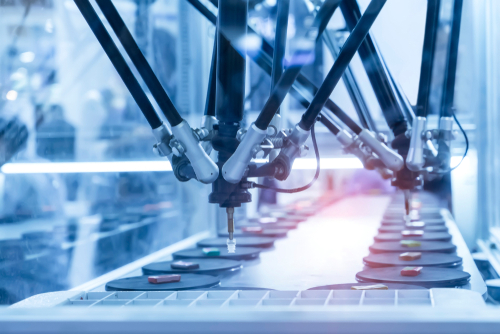
How Does AI-based Supply Chain Optimization Help Pharma Companies Save Money?

The pharmaceutical supply chain is incredibly complex: From sourcing and supplying materials to manufacturing and distribution of incredibly sensitive products that could be rendered inactive without the right environmental conditions.  This complexity – and the dependence of governments and populations on the pharmaceutical industry’s life-saving products – are why pharma supply chains are so important. …
Healthcare and ChatGPT: How Does Prompt Engineering Help?

In late 2022 Clifford Stermer posted a video on TikTok. The short clip showed the rheumatologist typing a prompt into OpenAI’s ChatGPT. The program then wrote a fully formatted letter to a medical insurance company, complete with treatment explanations, references, and a request for approval for a specific procedure on a specific patient.  The video went viral…

How AI Systems That Understand and Generate Code Can Improve Software Development

AI and machine learning (ML) systems are gaining more traction among large enterprises by the day. And it’s not hard to see why: ML models help organizations scale and improve various tasks, from medical device manufacturing to predicting Leukemia relapses.  Other AI models, such as diffusion and generative models, can generate synthetic voices, videos, or images. The latest emerging…

How Diffusion Models Are Promising Tools for Anomaly Detection in Medical Imaging

It’s well-known that machine learning models are good at detecting patterns, making decisions, and making other discriminative decisions based on previously learned training data. But a newer type of machine learning (ML) model is being used to tackle a growing range of use cases. We’re talking about generative models.  Generative models differ from discriminative models, which…

How Machine Learning and Machine Vision Can Benefit the Medical Device Manufacturing Process

Machine learning (ML) technologies have become key tools in the performance and administration of medical devices, including the production of clinical evaluation reports (CERs) manufacturers must regularly submit to stay compliant.  Device manufacturers also use ML capabilities to add powerful features and introduce new service models to capture recurring revenue streams and strengthen relationships with clients. The introduction…

Predicting Leukemia Relapses Through Time Series and Other Advanced Techniques

Every three minutes, one person in the U.S. is diagnosed with leukemia or a similar blood cancer. And every nine minutes, someone in the U.S. dies from these diseases. Indeed, leukemia and related conditions are devastatingly common, even in countries with advanced medical systems. The diseases comprised around 10 percent of new cancer cases in…

Almost Half of All Prosthetic Users Give Up on Their Medical Devices. Machine Learning Can Change That

The concept of prosthetic limbs has existed for thousands of years, with the earliest known prosthesis – a big toe – found in Egypt and dated to almost 1000 BCE. More recent history has seen the rapid development of different prostheses, including robot-powered limbs outfitted with dozens of sensors that gather real-time data about positioning, angle, and force exerted.…

How Machine Learning Can Help Prevent Type 2 Diabetes (And Its Complications)

Diabetes is one of the most potentially devastating ailments in existence, yet one of the most common: According to the American Diabetes Association (ADA), nearly 40 million Americans (or more than 10 percent of the population) had diabetes in 2019. According to the ADA, it’s a number that rises 1.4 million every year. Things aren’t…