

Understanding the LLM Architecture for Space Mission
Modern space missions generate a large amount of heterogeneous data, including orbital products, telemetry streams, fault logs, and operational context. This requires a robust LLM Architecture for Space Mission to interpret data under strict safety and certification guidelines.
Orbital Brain is a proof-of-concept (POC) architecture that combines Large Language Models (LLMs) into space mission analysis while adhering to operational realities. This design reflects actual ground-segment workflows, progressively transforming raw mission data into state awareness, operational guidance, and certification-ready explainability.
Why “AI Control” Misses the Point
In critical aerospace situations, spacecraft autonomy relies on pre-approved control laws and fault-protection logic. Including an unrestricted LLM in the command loop is neither certifiable nor safe. The right question is: How can AI help human flight controllers understand, predict, and plan mission operations? Orbital Brain uses the LLM as a Cognitive Augmentation Tool. It pauses before executing commands, allowing a Flight Director to review, challenge, and approve structured reasoning.
LLM Architecture for Space Mission: 7-Phase AI System
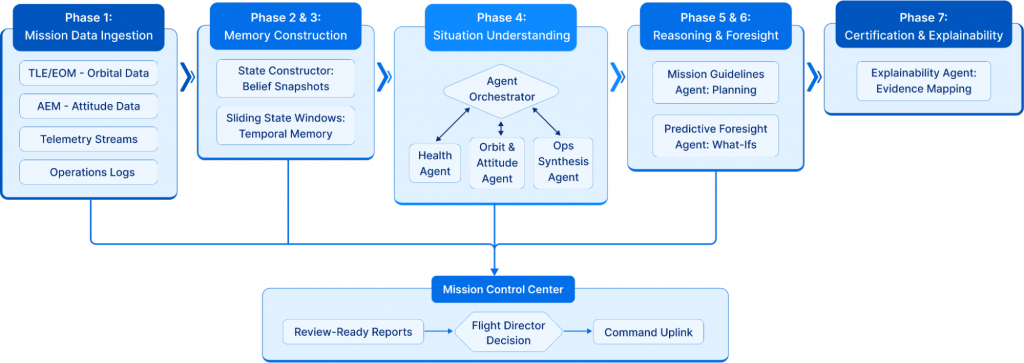
The Orbital Brain is organized as a multi-phase cognitive pipeline. Each phase enforces strict input/output contracts to ensure the system remains auditable.
Phase 1: Ingestion – Captures raw data such as TLE, OEM, AEM, Telemetry, and Logs.
Phase 2 & 3: State & Memory – Integrates raw data into “belief snapshots” and organizes them intotemporal sliding windows. This reflects how operators reason, not on single data points, but on trends.
Phase 4: Situation Understanding – Independent LLM agents like Health, Orbit, and Ops analyze the state windows to generate assessments.
Phase 5: Planning Guidance – Converts assessments into advisory, human-executable guidelines.
Phase 6: Predictive Foresight- Generates narrative “what-if” scenarios for the next 1–3 orbits, helping anticipate risks without over-relying on simulations.
Phase 7: Certification – Produces a narrative mapping evidence to recommendations, ensuring no decision is a “black box.”
This setup reflects how real mission control works: gather data, build awareness, plan, predict, and always explain your thinking.
Case Study: The “Telemetry Blackout” Scenario
To test the architecture, we simulated a real anomaly: a 2-hour telemetry blackout after transitioning from eclipse to sunlight. Here’s how the Orbital Brain agents handled this situation.
A. Situation Assessment (Phases 4 & 5)
The Health Agent flagged nominal power flags but insufficient battery voltage data, rating confidence low (40%). The Orbit Agent was confident in the trajectory but marked the internal state as “UNKNOWN” due to the gap.
The Ops Synthesis Agent bridged these findings:
“Risk is MODERATE. Trajectory is stable, but we are flying blind regarding internal recovery post-illumination. Priority 1 is ground contact.”
B. Predictive Foresight (Phase 6)
Instead of relying solely on physics simulations, Phase-6 provided a narrative risk profile for the next three orbits. If contact is not re-established, the risk would rise to HIGH, as potential battery degradation could trigger an autonomous “load-shedding” event during the next eclipse, without the operator’s knowledge.
C. Mission Guidelines (The Output)
The system generated a Mission Ops Planning Note, using advisory language:
- Preconditions: Ground contact must be re-established before any mode transitions.
- Non-Actions: Do not proceed with non-essential science operations.
- Safety Boundaries: Treat the next eclipse as a high-risk period.
Explainability: Key to Aerospace Certification
The most important component of Orbital Brain is Phase-7: The Explainability Report. In aerospace, a recommendation is useless if you cannot prove why it was made.
Our POC generates an “Evidence-to-Guideline Mapping.” For example, the guideline to “Collect battery voltage data across 3-5 cycles” is clearly linked to the evidence of “INSUFFICIENT_DATA” in the telemetry logs and the physical reality of the recent eclipse exit.
The report also includes a Human Accountability Statement, reminding the user that:
- LLM confidence scores are qualitative estimates, not statistical certainties.
- The Flight Director remains the final authority.
- The AI is identifying “illustrative possibilities,” not definitive forecasts.
Benefits of an LLM Architecture for Space Mission
Results and Observations
The implementation of this POC showed the following three important findings:
- Context Matters More than Raw Values: The LLM was most effective when it looked at the gap in data (the blackout) rather than just the available data.
- Multi-Agent Specialization: By separating “Orbit Tracking” from “Subsystem Health,” we prevented the agents from making “halo effect” errors (e.g., assuming a healthy orbit means a healthy battery).
- Safety Through Constraint: By prohibiting the LLM from authoring commands, the output remained professional, advisory, and aligned with standard mission operations.
Conclusion: The Future of the Cognitive Ground Segment
The future of AI in space is not cinematic autonomy but about disciplined decision support. Orbital Brain shows a practical, certifiable way to integrate LLMs into mission operations while honoring decades of aerospace safety culture.
By grounding AI in realistic workflows, data ingestion, state reasoning, planning, foresight, and explainability, we move from science fiction to deployable engineering. This architecture provides a blueprint for the next generation of ground segments, where AI manages the data deluge so that humans can manage the mission.
Technical Specifications & Code
The POC was developed using a modular Python framework, utilizing state-indexed JSON archives to simulate ground data repositories and prompt-engineered LLM agents for analytical phases. Explore the full implementation by clicking here.
Author’s Note: This article was supported by AI-based research and writing, with Claude 4.5 assisting in the creation of text and images.
Author

What exactly is "Orbital Brain"?
Think of it not as an “autopilot” for spacecraft, but as a “cognitive augmentation tool”. It’s a proof-of-concept LLM Architecture for Space Mission operations designed to help human flight controllers make sense of vast amounts of mission data, helping them predict risks and plan operations more effectively without ever taking the actual command authority out of human hands.
Why don't we just let AI control the spacecraft directly?
In spaceflight, safety and certification are non-negotiable. Putting an unrestricted AI in the command loop isn’t just unsafe—it’s currently impossible to certify. Instead, the LLM Architecture for Space Mission design follows the “human-in-the-loop” philosophy, ensuring that a human Flight Director always has the final say after reviewing the AI’s structured reasoning.
How does the system actually process mission data?
It uses a 7-phase cognitive pipeline. It starts by ingesting raw data, moves through organizing it into “belief snapshots” (rather than looking at single data points), and ends with generating narrative guidelines. This mimics how human operators think: gathering data, building awareness, predicting outcomes, and most importantly—explaining their logic.
How does it handle an emergency like a telemetry blackout?
During a blackout, the system doesn’t just guess; it acts as a synthesis engine. In a simulated 2-hour blackout, it combined health and orbit data to provide a “risk profile” for the next few orbits. It didn’t just report the problem; it suggested actionable priorities, like focusing on ground contact before attempting any other complex maneuvers.
How can we trust the AI’s advice?
Trust comes from explainability, specifically through “Evidence-to-Guideline Mapping”. For every recommendation the LLM Architecture for Space Mission provides, it maps it directly to the evidence found in the telemetry logs. If it tells you to collect specific data, it shows you exactly why the system marked the current data as “insufficient”.
Does the AI make the final call on mission-critical decisions?
Absolutely not. The system operates with a clear Human Accountability Statement. It reminds users that the AI is only providing “illustrative possibilities” and qualitative estimates, not statistical certainties, meaning the Flight Director remains the final authority for all critical decisions.
How does it avoid the "halo effect" where a good orbit masks a bad battery?
The system uses specialized, independent agents. By separating the “Orbit Tracking” agent from the “Subsystem Health” agent, the LLM Architecture for Space Mission prevents the AI from making sweeping, incorrect assumptions. It forces the system to look at each subsystem individually rather than assuming everything is healthy just because the ship is in the right place.
What is the real future of AI in space operations?
It’s not about cinematic autonomy; it’s about managing the data deluge. The future is about AI doing the heavy lifting of data analysis, ingestion, and foresight so that human mission controllers can focus their attention where it matters most: managing the mission itself.