
 Aldrin M
Building Intelligent Test Automation with Playwright and the Model Context Protocol

AI Test Automation
In modern software development, AI Test Automation plays a vital role in preventing test suite decay. A single design refresh can invalidate hundreds of locators overnight. The product itself remains fully functional. The submit button has simply moved, acquired a new class name, or been rebuilt as an entirely different element. Yet the regression suite turns red, and the team spends the following sprint repairing selectors instead of advancing coverage.
Anyone who has maintained a large Selenium or Playwright suite will recognize the pattern. Implementing effective AI Test Automation helps bridge the gap when traditional automation is not incorrect about the product’s behavior, but simply out of date about the page structure.
Successive generations of tooling have steadily reduced the friction. Selenium made reliable cross-browser automation practical at scale. Playwright further lowered flakiness through auto-waiting, direct communication with browser engines, and superior tracing. Neither, however, altered the fundamental arrangement: a human or code-generation tool still defines the locator, and a human still updates it whenever the page changes.
What is new is that a model can now read the page for itself and reason about what changed. Turning that reasoning into browser actions is the job of the Model Context Protocol (MCP). Performing those actions is the job of Playwright. This article sets out how the three pieces fit together, what the combination does well, and where it should stop.
How the Pieces Fit Together
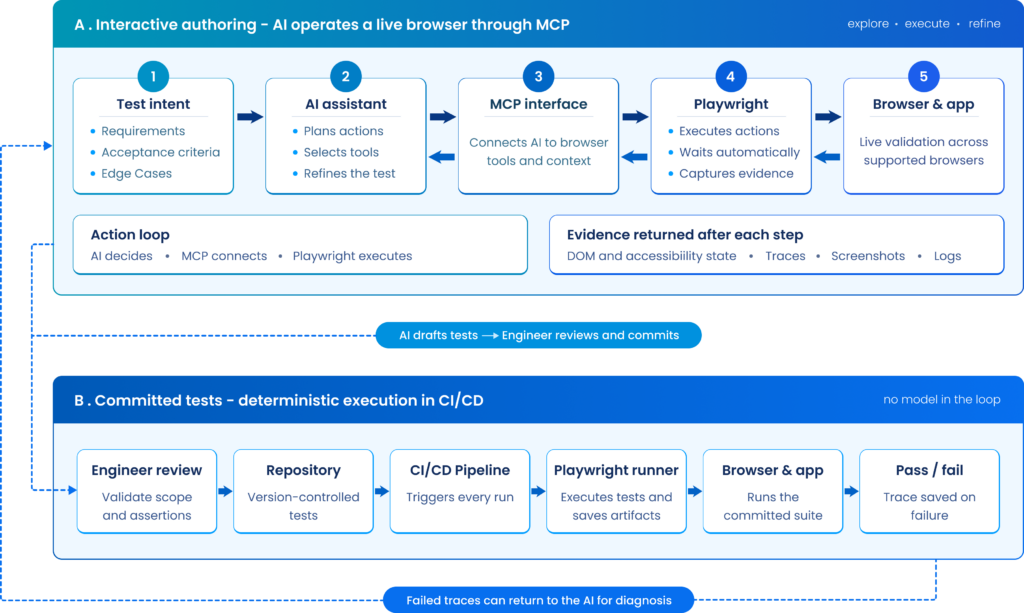
Start with the division of labor, because these three components are easy to conflate. Most of the confusion around AI-assisted testing comes from crediting one of them with another’s job. The relationship is a three-step loop.
– The model decides. It reads the requirement, forms a plan, and chooses the next action to take.
– MCP carries the decision. The protocol exposes browser actions to the model as callable tools and returns the results as structured context.
– Playwright acts. It drives Chromium, Firefox, or WebKit, waits for the page to settle, and reports what happened.
The intelligence sits in the model. MCP is plumbing: a well-specified, general-purpose transport with no opinions about testing. Playwright is the hands.
Why Playwright Suits an AI Caller
Take the components in turn, beginning with the one doing the acting. Playwright is an open-source browser automation framework from Microsoft that drives Chromium, Firefox, and WebKit through a single API. Rather than run through its feature list, ask a more useful question: which of its properties matter specifically when the caller is a model rather than a person?
Direct browser-engine communication. Playwright communicates with the browser over a single WebSocket connection rather than routing every command through an intermediate driver process. For Chromium, it uses the Chrome DevTools Protocol; for Firefox and WebKit, it uses patched builds that expose an equivalent interface. An agent may take dozens of small actions to work out what a page does, so lower latency and a smaller failure surface compound quickly.
Auto-waiting on actionability. Before acting, Playwright performs a series of actionability checks: the element must be visible, stable, able to receive events, enabled, and, where relevant, editable. A human author learns to add waits after being burned by their absence. A model generating one step at a time has no such instinct. Letting the framework absorb synchronization removes an entire class of error the model would otherwise have to reason about.
Accessibility-first locators. Methods such as getByRole(), getByLabel(), and getByText() address elements the way a user perceives them. That helps twice over. The locators survive markup churn better, and they use vocabulary a language model handles far more reliably than a positional XPath.
Tracing and rich artifacts. Traces, screenshots, console output, and the network log turn a failure into evidence. A model can only diagnose what it can observe, so the quality of these artifacts sets the ceiling on the quality of any AI failure analysis.
MCP as the Bridge to the Browser for AI Test Automation
Those artifacts are only useful if something carries them to the model, which is the job of the second component. MCP is an open protocol that standardizes how AI applications connect to external tools and data. It is deliberately general. The same specification connects models to databases, file systems, version control, and internal APIs. This article concerns only one of those uses, connecting a model to a browser, so what follows describes MCP in those terms while the protocol itself remains considerably broader.
In the browser case, an MCP server sits in front of Playwright and publishes its capabilities in the three forms the specification defines. Tools are actions the model can invoke, such as navigate, click, type, and snapshot. Resources are context the model can read, such as the accessibility tree, page state, and the current URL. Prompts are reusable instruction templates the server offers for recurring tasks. Microsoft maintains an official implementation, the Playwright MCP server, which is the fastest way to try this arrangement.
The consequence is what makes the arrangement useful for debugging. Because tool results return as structured context rather than as a screenshot pasted into a chat window, the model can hold the console output, the failing network request, the accessibility snapshot, and the trace at the same time, then reason across them. Instead of reporting that a click timed out, it can establish that the click timed out because the element never rendered, because a POST /api/cart returned 500. That correlation is the substantive benefit, and it comes from the protocol carrying good context rather than from the protocol being clever.
| Capability | Playwright Provides | MCP Provides | Combined Value |
|---|---|---|---|
| Test creation | Locators, assertions, fixtures, and a test runner to target | Requirement, page, and repository context delivered to the model | Drafts grounded in the real application rather than in a guess at its markup |
| Browser execution | Automation of Chromium, Firefox, and WebKit through one API | Browser actions published as governed, callable tools | Cross-browser execution: the model can drive one step at a time |
| Context collection | Traces, screenshots, console output, and network logs | Structured return of those artifacts to the model | Evidence-based diagnosis instead of a generic timeout message |
| Maintenance | Role- and label-based locators plus auto-waiting | Live access to the current accessibility tree and code | Locator repairs proposed against the page as it exists today |
| Governance | Deterministic runs and ordinary CI integration | Explicit client and server boundaries, plus capability negotiation | Automation that still passes through an auditable human gate |
Intelligent Test Generation
The first three rows of Table 1 are worth taking in turn, beginning with creation. A requirement such as “a customer should be able to purchase a product using a credit card” can be expanded into functional paths, boundary conditions, negative cases, and visual and accessibility checks. Security testing is deliberately absent from that list. It belongs to dedicated tooling, not to a UI automation stack, and promising it here would oversell what this combination does.
What lifts this above prompt-driven boilerplate is that the model can open the actual checkout flow through MCP before writing a line. It reads the real field labels, notices the promotional-code input nobody mentioned in the ticket, and sees which validation messages the form actually produces. The scenarios it proposes therefore reflect the application rather than a guess at it.
The deliverable is a concrete artifact: a static Playwright spec file (.spec.ts) that an engineer reviews and commits like any other code. It is a draft, not a merge. Reviewers should expect to correct over-specific assertions and to delete scenarios that duplicate coverage the suite already has.
Self-Healing Automation and the Challenges
Writing the test is the smaller half of the problem. Keeping a suite alive has traditionally meant hand-editing locators every time the interface shifts. Name the mechanism precisely, because self-healing is otherwise a vague claim.
When a locator stops matching, the model requests an accessibility snapshot of the current page through MCP and compares it against the element the failing locator was written to select. Because that snapshot exposes each element’s role, accessible name, and state, a submit button that has moved, been restyled, or been rebuilt as a different element is usually still identifiable as the button whose accessible name is “Place order.” The model proposes a replacement locator, ideally a semantic one such as getByRole(‘button’, { name: ‘Place order’ }), and explains what it matched against.
One boundary deserves drawing firmly. The output is a suggested change for review, not a silent runtime patch. A suite that rewrites its own locators mid-run can quietly convert a real regression into a green build, which is a worse failure than the one it was trying to avoid.
Intelligent Failure Analysis
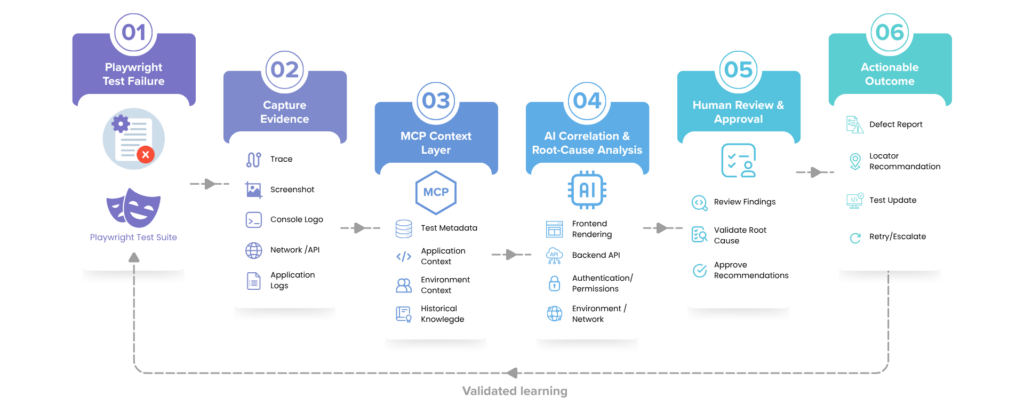
A proposed repair is only as good as the diagnosis behind it. Traditional frameworks return generic timeout or locator errors, and the engineer supplies the reasoning. With the artifacts available as structured context, that correlation work can happen before a human opens the report. Browser traces, screenshots, network activity, and application logs are read together rather than one at a time.
The practical difference shows up in the answer. Rather than “element not found,” the analysis distinguishes a backend error from an authentication failure, a permissions problem, network latency, or a frontend rendering issue, and it points at the artifact supporting the conclusion.
When Not to Use This
Every recommendation carries a cost, and this one carries four worth stating before you pilot it.
- Giving a model live browser control means giving it whatever the browser session can reach. Point it at a staging environment with synthetic data, never at production with real customer records or live credentials.
- The interactive lane consumes model tokens and wall-clock time per action. Exploratory agent runs are meaningfully slower and more expensive than executing a committed spec file, which is one more reason to keep them out of CI.
- Accessibility-based repair depends on the application having a usable accessibility tree. Canvas-rendered interfaces, unlabeled icon buttons, and heavily custom widgets give the model little to match against.
- Review capacity is the real constraint. Generated tests arrive faster than a team can read them, and unreviewed coverage is worse than no coverage because it looks like assurance.
Implementation Best Practices
None of those costs rules the approach out, and the habits that contain them are mostly the habits that make any Playwright suite work, with one addition about where the AI layer stops.
- Build modular frameworks. Keep page interactions, test data, and assertions separable, so you can review a generated test in isolation rather than read it as one long script.
- Prefer semantic selectors. Favor role- and label-based locators over CSS or XPath. These are the locators the model can also reason about from an accessibility snapshot, which is what makes repair suggestions possible later.
- Enable tracing, screenshots, and video on failure. These are not merely debugging conveniences. They are the input to every AI diagnosis, and a suite that discards them gives the model nothing to work from.
- Separate test data from test logic. Generated tests that hard-code data are the ones that break first.
- Commit the generated scripts. Run them as standard, deterministic tests in your existing CI/CD pipeline.
That last point deserves stating plainly, because it is usually the reassurance a skeptical team is looking for. The AI layer does not join the pipeline. It produces spec files, and the pipeline runs them exactly as it ran the handwritten ones. Nothing about CI becomes non-deterministic, and nothing in the deployment path depends on a model being available or behaving consistently. AI-generated tests should complement engineering review for business-critical workflows, never replace it.
The Road Ahead
The direction of travel points toward context-aware testing that spans more of the development cycle: natural-language test generation, risk-based selection of which regression tests to run, autonomous exploratory passes over new features, and AI-assisted triage of failures at scale. MCP matters to all of these for the same reason it matters here. It provides one standard interface between models and development tools, so an agent can correlate a UI failure with a recent commit, an open ticket, and a deployment log without a bespoke integration for each.
The constraint worth carrying forward is the same one Figure 1 draws. The further these capabilities extend, the more important it becomes that the deterministic, reviewed suite stays deterministic and reviewed.
Conclusion
The practical takeaway is narrower than the marketing around AI testing suggests, and more useful for being narrower. MCP provides a standardized bridge that lets a model inspect the state of a running application, reason across the artifacts a failure leaves behind, and draft Playwright automation against the page as it actually exists. Playwright provides an execution layer reliable enough to make that reasoning worth anything.
The shift is from an AI that generates code from a description to one that can look at the application, form a hypothesis, and check it. That is a debugging and drafting companion rather than a passive code generator. What it produces is still ordinary Playwright specs, still reviewed by an engineer, still run deterministically by CI. That is the point, not a limitation.
If you want to test the idea cheaply, take one recently broken locator, hand the model an accessibility snapshot of the current page, and compare its suggested repair against the one your team wrote by hand.
See Also
- For a deeper dive into the protocol architecture, see How MCP Architecture Scales AI Systems.
- To learn more about backend infrastructure design, visit Building Resilient AI Architectures with FastAPI.
Author’s note: This article was supported by AI-based research and writing, with Claude 5 assisting in the creation of text and images.
Aldrin M is a Senior QA Engineer with extensive experience in software quality assurance and test automation. He is proficient in Playwright, TypeScript/JavaScript, Selenium, Java, REST Assured, Postman, and TestNG, with hands-on experience designing and implementing robust UI and API automation frameworks. He has strong expertise in functional, regression, UAT, database, and API testing, with a focus on improving test coverage, automation efficiency, and overall software quality.